
Stratégie · 8 min read
Crossing the chasm: from a few BIM pioneers to the whole company
By Mickael Quinart · 9 October 2026
Why BIM often stays confined to a few enthusiasts, and how to move from pioneers to the majority of teams.
Hello everyone and welcome to the PALLADION blog! As Mickael Quinart, a BIM/CAD consultant, I am delighted to guide you through a topic that is essential for the success of any digital transition: the innovation adoption curve and, more specifically, how to overcome the famous "chasm" that separates early adopters from the majority of users.
The transition to BIM (Building Information Modelling) is not just a matter of technology; it is, first and foremost, a human, cultural, and organisational change. Understanding the dynamics of innovation is key to successful and sustainable adoption within your structure.
The Innovation Adoption Curve
All innovation diffuses according to a curve: innovators, early adopters, early majority, late majority, laggards. Between the early adopters and the majority lies a chasm: pioneers are convinced by novelty, while the majority demands proof, methods, and security.
This curve, popularised by Everett Rogers, is a fundamental model for understanding how a new idea or technology is adopted over time. "Innovators" are visionaries, willing to take risks. "Early adopters" are slightly more pragmatic but remain open to experimentation. Then comes the "chasm," that critical moment when innovation must prove its value to attract the "early majority," who are less adventurous and more concerned with reliability and tangible benefits. Ignoring this chasm means risking deployment failure, even with the most promising technology.
The Chasm in a Design Office
In many design offices, two or three enthusiasts master BIM. They deliver remarkable projects, but the rest of the team continues to work in CAD. BIM then depends on a few individuals: if they leave, the expertise disappears.
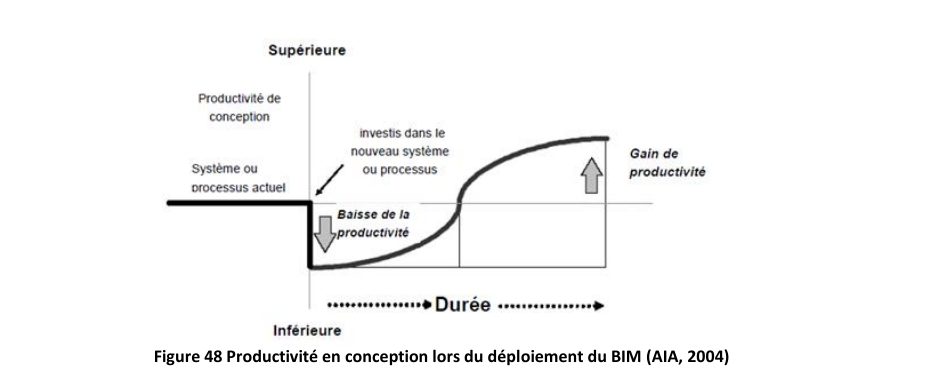
The figure above perfectly illustrates the challenge. We observe an initial drop in productivity due to the learning phase (the famous "learning dip"), followed by a gradual recovery. The role of pioneers is crucial in demonstrating that this curve can be overcome and that long-term gains are indeed real. However, if knowledge remains confined to this elite, the entire organisation will not be able to capitalise on the initial investment. This is a clear symptom of the chasm: the majority has not yet taken the plunge.
What the Majority Expects
For the majority to embrace BIM, it is imperative to address their legitimate concerns. The fear of the unknown, the apprehension of wasting time or not being up to the task, are powerful inhibitors.
| Expectation | Solution to provide |
|---|---|
| Clear methodology | Procedures, templates, tutorials |
| Proof | Quantified feedback from pilot projects |
| Security | Right to make mistakes, support from a mentor |
| Ready-to-use tools | Company libraries, validated families |
| Regained productivity | Planning for the learning dip |
These expectations are not whims, but fundamental needs for a smooth and effective transition. Management's role is to create an environment conducive to adoption, by providing the necessary resources and support.
Concrete Case Study in a Design Office
Imagine a structural engineering design office with two "pioneer" engineers who master Revit Structure and have already completed several studies using BIM modelling. They are capable of producing rich 3D models, extracting complex reinforcement drawings, and collaborating via IFC exchanges with the architect. However, the rest of the team, comprising about fifteen drafters and engineers, continues to work with AutoCAD for 2D plan production.
The management wishes to generalise BIM to meet the growing demands of clients (who are increasingly requesting BIM Level 2 or 3 deliverables, in line with ISO 19650) and to improve coordination. The pioneers are highly sought after for specific projects, but overall adoption is stagnating.
The majority of the team express doubts:
- "How long will it take to master Revit?"
- "Won't our production deadlines skyrocket?"
- "If I make a mistake, who will help me?"
- "We don't have rebar families for all our scenarios..."
- "Will we really save time in the end?"
These questions are an exact reflection of the chasm. To cross it, it will be necessary not only to train, but also to structure, support, and tangibly prove the added value of BIM.
Best Practices / Common Mistakes
To facilitate BIM adoption, it is crucial to adopt the right strategies and avoid common pitfalls.
| Best Practices | Common Mistakes |
|---|---|
| Train the majority, prioritising methodology and processes before tool mastery. | Limiting training to pioneers or to overly technical sessions unrelated to daily work. |
| Appoint internal mentors (the pioneers) who support the team daily, answer questions, and share their tips. | Leaving pioneers alone on their "BIM" projects, isolating them from the rest of the team, or turning them into "super-producers." |
| Implement standardised templates and libraries (e.g., Revit families) to accelerate onboarding and ensure consistency. | Letting each user create their own elements, leading to inconsistency and wasted time. |
| Choose pilot projects of progressive difficulty with strong support, and analyse lessons learned. | Imposing BIM on a complex, tight-deadline project, creating frustration and rejection. |
| Communicate concrete benefits (error reduction, improved coordination with tools like Navisworks or Solibri for clash detection, better project understanding) with measurable indicators. | Settling for generic discourse on the future of BIM without tangible proof of gains. |
| Promote interoperability with open formats like IFC and exchange protocols like BCF, for fluid collaboration. | Sticking to a closed ecosystem, hindering exchanges and coordination with partners. |
| Establish a clear and progressive roadmap for BIM deployment. | Deploying BIM haphazardly, without a long-term vision or defined stages. |
| Establish a right to make mistakes and an environment where asking questions is encouraged. | Blaming users who encounter difficulties or make mistakes during the learning phase. |
Step-by-Step Method
To cross the chasm, a methodical and structured approach is essential. Here are the key steps:
- Audit existing conditions and define the BIM vision: First and foremost, assess your design office's BIM maturity level. What software is used? What are the internal competencies? Then clearly define your BIM objectives (e.g., achieving ISO 19650 Level 2, improving clash detection by 30%). This vision must be shared by management.
- Transform pioneers into mentors and industrialise their practices: Do not leave your BIM experts isolated. Their role must evolve: they become mentors, internal trainers. Document their methods, their tips, and translate them into clear procedures, company templates (e.g., Revit or ArchiCAD templates), object libraries (families, typologies), and tutorials. Standardisation will enable knowledge duplication.
- Launch progressive pilot projects with support: Choose projects of increasing difficulty, representative of current activity but without excessive stakes. Assign a mentor to each involved team. The goal is to create a secure environment where experimentation is allowed. Use these projects to validate the established standards and measure the first gains.
- Train the majority and deploy team by team: Transition teams progressively, focusing on concrete training sessions, geared towards specific design office workflows. Ensure post-training follow-up via workshops, drop-in sessions with mentors, and a knowledge-sharing platform. The integration of document management and collaborative processes (Common Data Environment - CDE) is essential.
- Evaluate, communicate, and adjust: Regularly measure performance indicators (production time, number of errors, quality of deliverables). Share these successes (even modest ones) with all staff. Visualisation tools like Navisworks or Solibri can help demonstrate the benefits of coordination. Lessons learned (REX) from pilot projects are crucial for continuously adjusting the method and tools.
How to Cross It
- Transform pioneers into mentors rather than "super-producers."
- Industrialise their practices into company standards.
- Choose representative, not exceptional, pilot projects.
- Communicate measured gains.
- Deploy team by team with support.
Vigilance Points
Crossing the BIM chasm is fraught with pitfalls. Here are the points to which particular attention must be paid:
- Management support: Without firm and visible commitment from management, any BIM deployment project risks running out of steam. Management must allocate resources (time, budget, personnel) and communicate the vision.
- Managing the "learning dip": Anticipate the initial drop in productivity. Plan margins on the schedules of the first BIM projects and ensure constant technical and moral support for the teams.
- Excessive or insufficient standardisation: Finding the right balance is key. Overly rigid standards can hinder innovation and adaptation. Overly loose standards lead to inconsistency and low efficiency. Templates, families, and processes must be robust yet scalable.
- Continuous training: BIM is a constantly evolving field. Training should not be a one-off event but a continuous process to keep skills up-to-date and integrate new technologies or standards (e.g., developments in IFC or ISO 19650).
- A culture of sharing and collaboration: BIM relies on information exchange. Encourage a culture where collaboration is the norm, not the exception. Issue management tools (BCF - BIM Collaboration Format) are essential for structuring these exchanges.
- Resistance to change: Some collaborators may be reluctant. Listen to their concerns, offer tailored training, and highlight the benefits for their daily work. Dialogue is the best weapon against resistance.
Key Takeaways
- Between pioneers and the majority, there is a chasm.
- The majority expects methodology, proof, and security.
- Pioneers become mentors; their practices become standards.
The BIM transition is a marathon, not a sprint. By adopting a strategic, empathetic, and well-structured approach, your design office will not only be able to cross the chasm but also thrive thanks to the immense opportunities offered by Building Information Modelling. Do not hesitate to contact us at PALLADION for tailored support in this endeavour!
Article based on the professional thesis "BIM transition and optimised deployment, applied in an engineering firm".
Mickael Quinart, PALLADION
Want to go further?