
BIM · 8 min read
Motivating and organising a BIM team in an engineering firm
By Mickael Quinart · 8 October 2026
Engineering firm and BIM hierarchy, roles of the BIM manager and coordinators, motivation levers: organising people to succeed with BIM.
BIM is first and foremost a collaborative and structured approach, but its success intrinsically relies on team buy-in and motivation. Beyond software and technology, it is the people who bring digital models to life and transform processes. As a BIM/CAD consultant at PALLADION, I am convinced that neglecting the human aspect is the primary cause of failure in a BIM deployment.
BIM is Primarily About People
Tools alone are not enough: it is the teams that make or break a BIM deployment. This thesis draws on motivation theories and the analysis of design office organisations to propose a clear framework.
The Importance of Individual Commitment
The transition to BIM often represents a profound change in working methods. It's not just about learning new software, but about understanding a new philosophy of design, coordination, and data production. Without genuine commitment from every team member, this transformation cannot succeed. Resistance to change, fear of the unknown, or a lack of understanding of the benefits can quickly become major obstacles.
The Motivation Process
Motivation is not an on-off switch, but a dynamic process influenced by several interconnected factors. Understanding this process is essential for managers and BIM leads who wish to engage their teams.
Based on the company's input data, the employee engages in an action according to their expectations (objectives, choices, training, resources). The result obtained must be perceived as useful (instrumentality) through clear statements, consistent rewards, and remuneration. Finally, valence depends on the satisfaction of needs and adherence to a social norm, which leads to recognition.
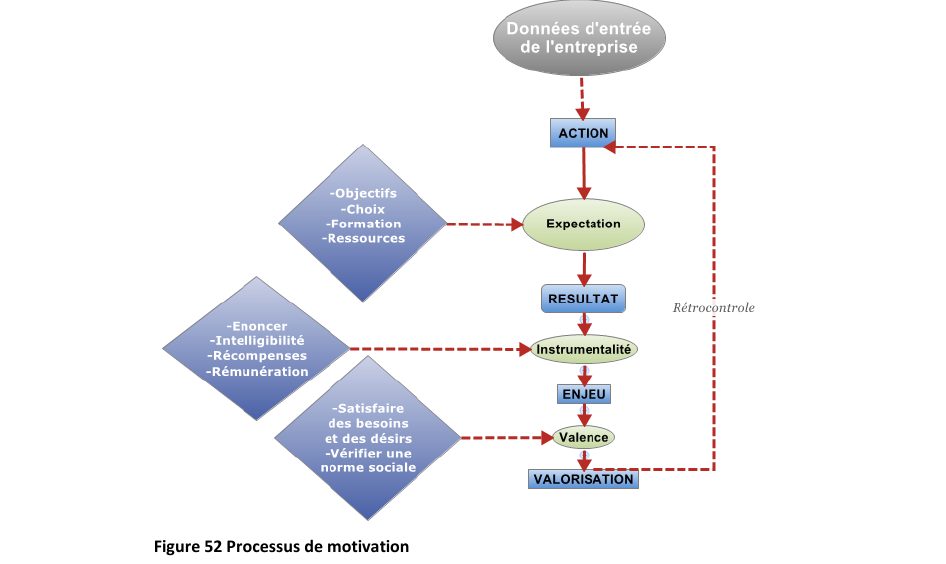
Concretely, a technician will invest in BIM if they understand the objective, have the means to achieve it, see the benefit of the outcome, and receive recognition for it.
Let's decode this process as applied to BIM:
Expectations:* The employee must perceive that investing in BIM will lead them to desirable objectives, and that they will have access to the necessary training, software (e.g., Revit, Archicad, Allplan), and resources (templates, families, procedures) to achieve them.
Instrumentality:* Efforts invested in BIM must clearly lead to tangible and beneficial results, both for the company (more efficient projects, fewer errors) and for the individual (skill development, recognition, better project management). Responsibilities associated with BIM roles (BIM Manager, BIM Coordinator) must be well-defined and valued.
Valence:* The satisfaction of having participated in a successful BIM project, recognition from peers and management, and the sense of belonging to an innovative team contribute to this valuation.
Superimposing the BIM Organisation on the Design Office Organisation
The introduction of BIM is not intended to revolutionise the existing hierarchical structure of a design office, but rather to add a specific functional layer, essential for project information management.
BIM does not replace the design office hierarchy: it superimposes itself upon it. The Design Office Director retains responsibility for production; the BIM Manager drives strategy and methods; BIM Coordinators ensure consistency between disciplines; project managers and teams of technicians and engineers produce the output.
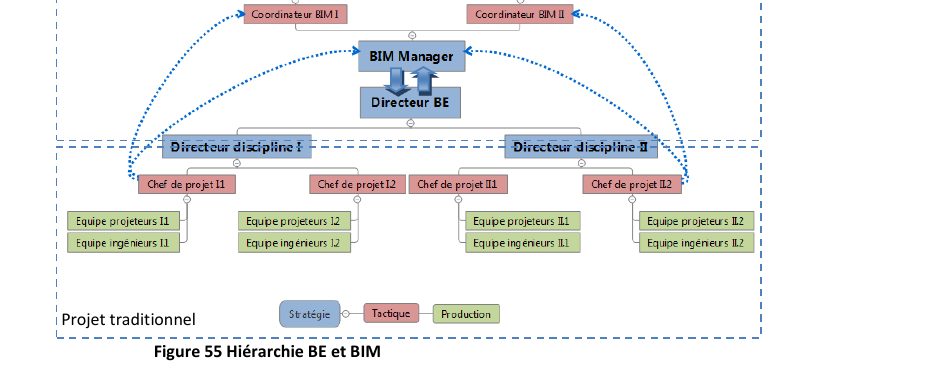
There are three levels: strategic, tactical, and production.
Details of Roles and Levels:
Strategic Level: The BIM Manager* operates at this level. They define the company's BIM vision, long-term objectives, protocols (inspired by ISO 19650), technological framework, and standards. They ensure technology watch and knowledge capitalisation. They are the key person for implementing the BIM roadmap.
Tactical Level: BIM Coordinators* and sometimes Project Managers operate here. The BIM Coordinator is responsible for the quality and consistency of the multidisciplinary digital model. They implement the BIM Manager's directives at the project level, ensure proper execution of BIM protocols, manage information flows (IFC, BCF), and organise clash detection meetings (e.g., with Navisworks).
Production Level:* Technicians, engineers, and architects who model (often using Revit, Archicad, Tekla Structures, etc.) and populate the models. They are the direct actors in the production of BIM deliverables. Their skill development and adoption are paramount.
Practical Case Study in a Design Office
Let's imagine a design office specialising in structures and MEP, undergoing a transition to BIM. Initially, integration is limited to using 3D modelling software for producing drawings, without a true collaborative BIM process.
The Design Office Director decides to structure the BIM approach. They assign one of their most experienced and motivated engineers to become the BIM Manager. The latter, after in-depth training and a monitoring phase, establishes a roadmap: defining BIM objectives (error reduction, improved coordination), software selection, development of templates and families, and drafting an internal BIM protocol.
In parallel, two lead technicians, one for structures and one for MEP, are appointed as BIM Coordinators for pilot projects. They undergo specific training in coordination, data exchange (IFC), and clash detection. Their role is to ensure the consistency of discipline models and their interoperability, by organising project reviews with the architect and other trades.
At the production level, all technicians and engineers receive training in software (e.g., Revit) and BIM working methods (element naming conventions, Levels of Information Need (LOIN) and Geometry (LOG)). Initially, resistance is palpable: "it takes longer", "I wasted less time with 2D". The BIM Manager and BIM Coordinators then set up exchange sessions, demonstrate concrete benefits on the first projects (fewer revisions on site, better project understanding), recognise individual and collective successes, and adjust processes based on field feedback. The success of pilot projects and the recognition given to pioneers create a virtuous circle, encouraging all teams to invest more.
Step-by-Step Method
To achieve a human-centric BIM deployment:
- Define a clear vision and communicate the "why": Explain the profound reasons for transitioning to BIM (quality improvement, competitiveness, innovation, new markets) at all levels. Leadership must champion this vision.
- Identify and train "BIM champions": Select motivated and influential employees at every level (strategic, tactical, production) to be the drivers of change. Invest in their training and empower them to act.
- Establish a structured framework: Define clear roles, protocols (BIM Execution Plan, graphical charter), templates, and BIM object libraries. Relying on standards like ISO 19650 for information management can be greatly beneficial.
- Ensure continuous and adapted training: Don't limit training to initial software instruction. Offer regular workshops, knowledge sharing sessions, and training on specific topics (coordination, data exploitation, clash detection tools like Navisworks or Solibri).
- Celebrate successes and learn from failures: Recognise efforts and achievements, however modest. Analyse difficulties encountered not as failures, but as opportunities for process improvement and skill development.
- Instil a culture of feedback and continuous improvement: Encourage team feedback on tools, processes, and training. The BIM approach is evolving and must adapt to on-the-ground realities.
Best Practices / Common Mistakes
| Best Practices | Common Mistakes |
|---|---|
| Transparent communication on BIM objectives and benefits. | Imposing BIM without explanation or consultation. |
| Tailored training for each role and need. | One-size-fits-all and generic training. |
| Valuing efforts and successes. | Minimising difficulties or failing to acknowledge progress. |
| Appointing internal BIM leads (BIM Managers, Coordinators). | Leaving teams to fend for themselves. |
| Providing clear resources (templates, charters, procedures). | Absence of standards or reference documents. |
| Actively listening to field feedback and adjusting processes. | Lack of flexibility in response to user feedback. |
| Starting with pilot projects then gradually scaling up. | Trying to deploy everything at once without an experimentation phase. |
Levers to Activate
- Explain the why before the how.
- Set achievable and measurable goals.
- Provide training and resources (templates, families, procedures).
- Recognise progress and project successes.
- Identify champions within each team.
Points of Vigilance
- The Magic Tool Syndrome: Don't believe that a simple piece of software (e.g., Revit) will solve all problems. BIM is a process before it is a technology.
- Resistance to Change: Expect reluctance. It's natural. Address it through communication, training, and demonstrating benefits.
- Neglecting Continuous Training: BIM tools and practices evolve rapidly. One-off training is not enough; skill development must be an ongoing process.
- Overloading Roles: Do not add BIM responsibilities to existing tasks without readjustment. BIM Manager and BIM Coordinator roles require dedicated time and resources.
- Lack of Standardisation: Without clear templates, protocols (like a BIM Execution Plan - BEP), and processes, BIM risks becoming "spaghetti BIM"—inefficient and a source of confusion. Interoperability (via IFC) and issue management (via BCF) are crucial.
- ISO 19650: While not mandatory for all projects, this series of international standards on information management throughout the life cycle of built assets using BIM offers a robust methodological framework and is an essential reference for structuring one's approach.
Key Takeaways
- Motivation follows a process: expectation, result, instrumentality, valence, recognition.
- The BIM organisation overlays the existing design office hierarchy.
- Three levels: strategy, tactical, production.
- Recognition and clear objectives are decisive.
In conclusion, the BIM transition is a marathon, not a sprint. It demands perseverance, a clear strategy, and, above all, constant attention to the needs and motivations of the teams. Investing in the human factor is the most cost-effective investment for a successful and sustainable BIM deployment.
Article based on the professional thesis "BIM transition and optimised deployment, applied in an engineering firm".
Mickael Quinart, PALLADION
Want to go further?