Management · 9 min read
BIM governance: designing the target organisation chart of an engineering firm
By Mickael Quinart · 9 October 2026
Strategic, tactical and production levels: how to integrate BIM managers and coordinators into a firm's organisation without conflict.
Hello everyone, Mickael Quinart, BIM/CAD Consultant at PALLADION.
BIM is far more than just a technology; it's a profound transformation of working methods that impacts the very structure of our organisations. I often observe a fundamental error: integrating BIM as a mere technical layer without considering its interaction with the existing hierarchical structure. It is from this friction that inefficiencies and conflicts arise.
This guide aims to shed light on how to harmonise the BIM functional line with your design office's (DO) traditional hierarchical line, for a smooth and effective BIM transition.
A Dual Line That Must Remain Clear
BIM creates a functional line (methods, standards, coordination) that intersects with the design office's hierarchical line (management, project managers, teams). If ill-defined, this dual line generates conflicts: who arbitrates between deadlines and model quality?
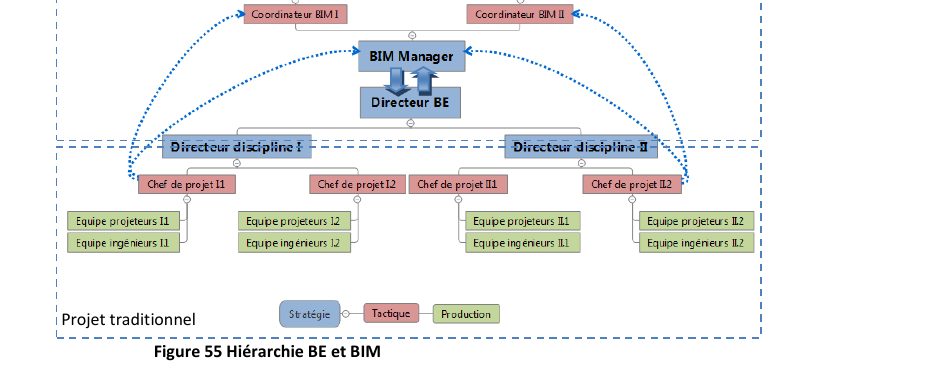
The figure above perfectly illustrates this superposition. On one side, a classic pyramid structure with management at the top, intermediate project managers, and production teams at the base. On the other, transversal BIM functions: the BIM Manager defining the strategy, BIM Coordinators ensuring project-by-project consistency, and modellers/technicians applying the standards. The challenge is to ensure these two lines collaborate rather than clash.
The Three Levels of Governance
For this collaboration to be fruitful, it is essential to define clear levels of governance, each with its specific stakeholders and responsibilities.
| Level | Stakeholders | Responsibilities |
|---|---|---|
| Strategic | Management, BIM Manager | Objectives, budget, standards, commercial offering |
| Tactical | Project Managers, BIM Coordinators | Project-specific Information Protocol, coordination planning, exchange quality |
| Production | Engineers, Technicians, Modellers | Modelling, calculations, drawings, self-checking |
This table highlights the distribution of roles. At the strategic level, management and the BIM Manager define the long-term vision, investments (software such as Revit, Navisworks, or collaborative CDE platforms compliant with ISO 19650), corporate standards (templates, object libraries), and the integration of BIM into the DO's value proposition. This is where decisions are made regarding whether the DO will pursue higher levels of information (LOD/LOIN) or embrace IFC for interoperability.
At the tactical level, project managers and BIM coordinators translate this strategy into concrete actions for each project. They develop the Project BIM Information Protocol (which often aligns with client requirements defined in the EIR - Employer's Information Requirements), plan coordination meetings (using tools like BCF for clash management), and ensure the quality of digital deliverables.
Finally, at the production level, engineers, technicians, and modellers are the artisans of BIM. They carry out modelling according to standards, perform calculations (structural, thermal, etc.) from the model, generate graphic deliverables (plans, sections), and are responsible for self-checking their output.
The Rules That Prevent Conflicts
Without clear rules, this dual line can become a source of tension. Here are the fundamental principles to prevent them:
- The Project Manager remains responsible for the deadline, budget, and deliverable. Their mission is to ensure the overall success of the project, integrating the BIM dimension.
- The BIM Manager guarantees the company's methods and standards. They ensure the consistency of BIM practices across all projects and the development of internal skills. They are the technical and methodological reference point.
- The BIM Coordinator guarantees the consistency of the model on the project. Their role is to orchestrate model production, detect clashes, and facilitate model reviews, often using visualisation and clash detection software.
- Deadline/quality arbitrations are escalated to the next level according to a documented rule. This is a crucial point. A disagreement between the need for speed and the requirement for model quality must be able to be escalated to the competent authority, often the project manager in conjunction with the BIM Manager, for a clear and documented decision.
Scaling According to DO Size
BIM organisation must adapt to the size of your structure. There is no single model, but rather principles of adaptation.
- Small DO (fewer than 10 people): A part-time BIM champion combines management and coordination. This person is often a passionate technician or engineer who has developed specific skills. They are the point of contact for all BIM queries and monitor technological developments.
- Medium DO: A BIM Manager and a coordinator per discipline. Here, the complexity of projects and the diversity of expertise justify specialisation. The BIM Manager defines the overall strategy, while the BIM Coordinators (structural, MEP, architectural, etc.) manage the application within their respective domains, ensuring interoperability between discipline models via IFC, for example.
- Large DO: Central BIM unit, project-specific coordinators, champions within each team. The size and multitude of projects require a more robust BIM structure. The central unit develops standards, R&D, and training. Project coordinators are dedicated to each operation for precise management, and champions within teams provide the first line of support and quality control.
Formalising Governance
Clarification is not enough; formalisation is the key to effectiveness and sustainability.
- Draft role descriptions (missions, deliverables, contacts). Each stakeholder must know precisely what is expected of them, with whom they should interact, and what the concrete results of their BIM work are. These descriptions must be dynamic and evolve with the DO's BIM maturity.
- Integrate the roles into each project's BIM Information Protocol. The Project BIM Information Protocol is the contractual document that specifies the objectives, uses, processes, responsibilities, and BIM deliverables for a given operation. Explicitly including the DO's internal roles provides clarity for all internal and external stakeholders.
- Plan a quarterly BIM Committee to evolve standards. This committee, composed of the BIM Manager, management representatives, and discipline coordinators or champions, is essential for continuous improvement. It allows for sharing project feedback, adjusting internal standards, validating investments in tools and training, and monitoring developments in standards (e.g., ISO 19650 series) and software.
Practical Case in a Design Office
Imagine a medium-sized multidisciplinary design office specialising in commercial buildings. The DO has already begun its BIM transition, but tensions regularly arise. Project managers complain that models are not ready in time for client submissions, while modellers feel pressured and attribute this to a lack of time to meet the quality standards defined by the BIM Manager.
The problem lies in a lack of clarification of the dual line. The project manager, focused on the overall deadline for the final deliverable (drawing package), may overlook crucial intermediate BIM coordination stages. The BIM coordinator, on the other hand, is focused on clash detection and model consistency but may feel subordinate to the project manager without the leeway to insist on additional model reviews or the correction of major issues identified with BCF.
By implementing formalised governance, the BIM committee decides, for example, to systematically include specific BIM "gates" in the general project schedule. These "BIM gates" are milestones where model quality is validated (e.g., inter-disciplinary model review, clash detection report, compliance check against IFC requirements). The project manager must then integrate these deadlines into their overall schedule. In case of non-compliance with a BIM gate, an arbitration procedure (defined in the documented rule) is triggered, escalating to the technical director and BIM Manager if necessary. This ensures that model quality is not systematically sacrificed for the sake of deadlines, and that every stakeholder understands their responsibilities and level of authority.
Best Practices / Common Mistakes
| Best Practices | Common Mistakes |
|---|---|
| Clarify roles and responsibilities for everyone, including decision-making authority. | Assuming everyone understands the implications of BIM on their role. |
| Formalise arbitration procedures and problem escalation. | Allowing deadline/quality conflicts to be managed ad hoc, without a framework. |
| Integrate BIM into the overall project schedule with dedicated milestones. | Viewing BIM as an additional task, outside the project's critical path. |
| Invest in continuous training for all stakeholders, at all levels. | Training only modellers, forgetting project managers and management. |
| Use collaborative tools (CDE, BCF) for maximum traceability and efficiency. | Relying on file exchanges via email, without a structured process. |
| Establish a regular BIM Committee for continuous improvement. | Lacking a forum for standard evolution and lessons learned. |
| Define clear internal standards (templates, object libraries, naming conventions). | Allowing each technician to "do their own thing," leading to inconsistency. |
| Promote interoperability via IFC and regular checks. | Working in closed software silos without concern for data exchange. |
Step-by-Step Method
Here is a structured approach to implement effective BIM governance in your DO:
- Assessment and Diagnosis: Analyse your DO's current organisation, identify key stakeholders, and evaluate your BIM maturity. What existing frictions are there? What strengths can be leveraged?
- Strategic Definition: In collaboration with management, define the company's BIM vision (objectives, targeted uses, software and hardware investments, etc.). It is at this stage that the BIM Manager is appointed and tasked.
- Role and Process Formalisation: Draft role descriptions for BIM functions (BIM Manager, BIM Coordinators, Modellers). Establish procedures for the development and validation of Project BIM Information Protocols, coordination methods, and arbitration rules.
- Structure Implementation: Create the BIM Committee and define its frequency and agenda. Adapt the organisational chart to clearly integrate the BIM functional line and its interactions with the hierarchical line.
- Training and Support: Train all teams in new BIM processes and tools (Revit, Navisworks, etc.). Provide continuous support to BIM stakeholders and project managers for smooth adoption.
- Continuous Improvement: Regularly facilitate the BIM Committee to gather feedback, adjust standards, develop skills, and maintain technological and regulatory watch (especially ISO 19650).
Watch Points
- Resistance to change: BIM integration disrupts habits. Anticipate and support teams.
- Overburdening BIM stakeholders: Ensure BIM teams are appropriately resourced to avoid overwork and burnout.
- Lack of management commitment: Without strong management support, BIM transformation will struggle to take hold.
- Vague data governance: Who owns which information in the model? Clarification is essential, especially in a CDE (Common Data Environment) as required by ISO 19650.
- Interpretation of standards: Standards like ISO 19650 provide a framework, but their application must be adapted to the DO's size and context.
- Tool obsolescence: The BIM world evolves quickly. Regular technological watch is essential to remain competitive.
Key Takeaways
- BIM overlays the hierarchy: the dual line must be clarified.
- Three levels: strategic, tactical, production.
- Documented role descriptions and arbitration rules prevent conflicts.
By implementing these principles, your design office can fully leverage BIM's potential, not as an additional constraint, but as a driver for performance and innovation.
Mickael Quinart, BIM/CAD Consultant (PALLADION).
Article based on the professional thesis "BIM transition and optimised deployment, applied in an engineering firm".
Mickael Quinart, PALLADION
Want to go further?