
BIM · 9 min read
BIM barriers: cost, skills and resistance to change
By Mickael Quinart · 5 October 2026
Cost (62%), lack of skills (52%), resistance to change (52%): understand and remove the three main barriers to BIM deployment.
Hello everyone and welcome to the PALLADION blog. As a BIM/CAD consultant, I support many companies in their digital transition and adoption of BIM. Today, we will delve into a crucial topic: the obstacles to this transformation. Understanding these hurdles is the first step to effectively overcoming them.
Three Obstacles Explaining the Majority of Blockages
A study conducted with 505 French companies on barriers to digital development (Callson and Berger, 2014) highlights three major obstacles. My field experience confirms this: whenever discussions take place across different hierarchical levels within a company, these three barriers almost systematically emerge.
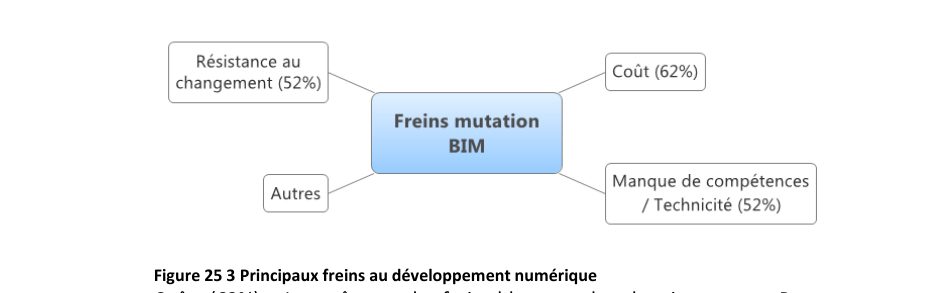
- Cost (62%)
- Lack of skills / technical expertise (52%)
- Resistance to change (52%)
It is therefore pertinent to focus efforts primarily on these three parameters to ensure the success of your BIM initiative.
Cost: An Investment to Smooth Out
Any transformation involves an initial investment: tools (software, licences), training (initial and ongoing), and the implementation of new processes (definition of standards, creation of libraries). This upfront expenditure may seem significant but can and should be smoothed over time. More importantly, it is followed by an often significant return on investment (ROI) in the medium and long term (reduction of errors, improved coordination, time savings on site, etc.).
The underlying risk is a temporary slowdown in activity, as staff are engaged in training or must adapt their procedures. This generates a perception of "hidden cost" or initial "loss of productivity".
Comparing these costs with the phases of the French Public Procurement Act (Loi MOP) and MacLeamy's curve helps to visualise them: BIM does not create an overall additional cost; it shifts effort towards design. By investing more upfront in modelling and coordination (Sketch, Preliminary Design (APS), Detailed Preliminary Design (APD), Tender Documents/Execution Design (PRO/DCE) phases), the risks and modification costs during the execution phase are drastically reduced. This is the very principle of collaborative work structured by the digital model.
Initial Productivity Drop is Normal
When introducing a new system, new tools, or new methods, productivity initially drops before exceeding the original level once the tools and methods are mastered. This phenomenon is universal and must be anticipated.
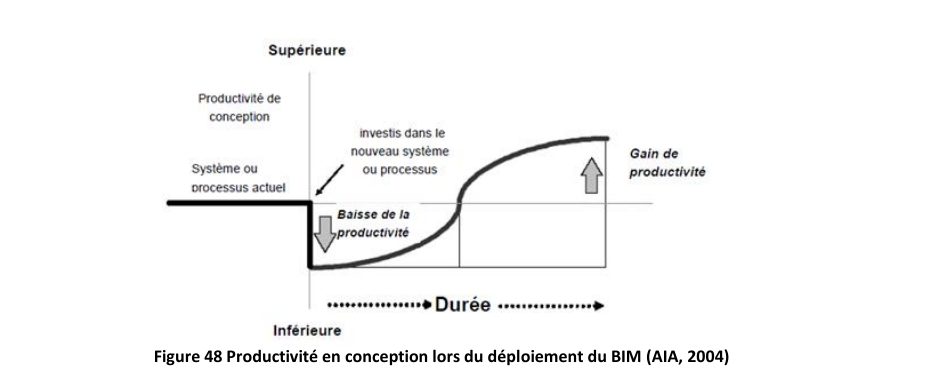
Anticipating this trough, planning for it, and clearly communicating it to all teams and management prevents abandoning the project at the worst possible time. It is a necessary learning phase, a "normal" step in the transformation process. Realistic BIM project management includes this period of adaptation.
Skills: Evolving Rather Than Replacing
The lack of skills is not solely addressed by recruiting individuals already expert in BIM. This is a costly and often insufficient strategy. Existing drafters and technicians, often from a CAD (Computer-Aided Design) background, possess invaluable industry knowledge (construction methods, technical standards, material specifics, rebar, layout, formwork, etc.). This human capital is priceless and must be retained and leveraged.
The key is to "evolve" these skills: it's about transposing existing expertise into new BIM tools and methods. Training must be progressive, adapted to each individual's level (basics for some, advanced for others) and anchored in real-world cases (the company's concrete projects). The objective is not to create "software operators", but "BIM actors" who understand the overall process.
Resistance to Change: A Human Issue
Resistance to change is not a flaw in teams; it is a natural reaction to the unknown, to losing familiar bearings, and to the fear of not being up to the task. It is often an indicator of a lack of information, communication, or support. It is addressed by:
- involving collaborators from the outset in defining the method and objectives (workshops, discussion groups);
- clear, achievable, and shared objectives, demonstrating the concrete benefits of BIM;
- recognising progress and efforts made, even the smallest ones;
- local support (internal referents, available BIM Manager, easily accessible technical support, mentors) and the establishment of a culture of mutual assistance.
Concrete Case in a Design Office
Let's take the example of a medium-sized structural design office (around twenty employees) wishing to transition from 2D CAD to 3D BIM for the design of its reinforced concrete structures.
The management team has identified the necessity of this transition in the face of increasing client demands and market evolution. However, they anticipate the three major obstacles:
1. Cost: This involves investment in software licences (e.g., Revit Structure, Tekla Structures, or Allplan Engineering), more powerful computer workstations, and initial training. The total cost is estimated at X thousand euros for the first year.
2. Lack of skills: The majority of drafters have been accustomed to 2D drawing for years. They perfectly master construction details but have no experience in 3D modelling, let alone collaborative BIM processes.
3. Resistance to change: Some experienced drafters express fears: "I'll be wasting my time," "It's pointless, my 2D method works perfectly well," "I'm too old to learn new software," "It will slow us down on current projects."
To overcome these obstacles, the design office could implement a multi-pronged strategy:
- Cost Management: Spread the purchase of licences and training over several financial years. Negotiate with software vendors. Highlight the expected long-term ROI (reduction of connection errors, time savings on modifications, better understanding of plans by site teams).
- Skills Development: Select a small group of voluntary and motivated drafters for pilot training. Transform them into "internal referents". Organise targeted training on specific functionalities and practical cases derived from their projects. Foster mentoring. Allow teams time to experiment and make mistakes without pressure.
- Change Management:
- Clear and transparent communication: Explain why the design office is adopting BIM (competitiveness, better design quality, client satisfaction).
- Involvement: Create an internal BIM working group to define standards, templates, and processes in collaboration with the drafters.
- Demonstration of benefits: Start with a simple project and quickly show the gains: clash detection, automatic quantity take-offs, 3D visualisation for the client.
- Recognition: Value the efforts of employees who invest themselves in the approach, through positive feedback, symbolic rewards, or career progression.
- Continuous support: Appoint a BIM Manager or a referent who will be the daily point of contact for all technical or methodological questions.
By adopting this structured approach, the design office will significantly increase its chances of success in its transition to BIM, turning obstacles into levers for development.
Step-by-Step Method
To approach the BIM transition in a company with confidence, here is a method in a few key steps:
1. Audit and Strategic Vision:
* Conduct an internal audit of existing processes, tools, and skills.
* Clearly define the vision and strategic objectives of BIM for the company (e.g., improve quality, reduce errors, gain competitiveness, meet market demands).
* Establish a realistic budget including software, hardware, training, and support.
2. Tool Selection and Targeted Training:
* Select BIM software relevant to your profession (e.g., Autodesk Revit, Graphisoft ArchiCAD, Nemetschek Allplan, Tekla Structures).
* Plan progressive and modular training, adapted to the roles and skill levels of each employee (job-specific software training, BIM methodology training, collaborative process training).
* Identify internal referents or a BIM Manager for daily support.
3. Pilot Project and Standard Setting:
* Choose a medium-sized project, not too complex but representative, to serve as a pilot project.
Define the initial internal BIM protocols, templates, object libraries (compliant with standards such as ISO 19650*).
* Implement regular coordination meetings and use collaborative communication tools (CDE - Common Data Environment platform).
4. Progressive Deployment and Feedback:
* Gradually extend BIM usage to other projects and teams, learning lessons from the pilot project.
* Establish regular feedback loops (REX - Retour d'EXpérience) to identify areas for improvement and adjust processes.
* Celebrate successes to maintain team motivation.
5. Optimisation and BIM Ecosystem:
* Integrate complementary tools (e.g., Navisworks for clash detection, Solibri for quality control, BCF tools for issue management).
Develop interoperability via open formats such as IFC (Industry Foundation Classes)*.
* Participate in the BIM ecosystem (communities, trade fairs, exchanges with other companies) to stay up-to-date and share best practices.
Best Practices / Common Mistakes
| Best Practices | Common Mistakes |
|---|---|
| Cost: | |
| Define a clear and measurable ROI. | Viewing BIM purely as a cost, without evaluating its benefits. |
| Smooth out the investment over time. | Investing everything at once without financial planning. |
| Highlight long-term gains. | Focusing solely on the initial cost. |
| Skills: | |
| Train the existing team and capitalise on their expertise. | Only recruiting new BIM profiles without valuing existing staff. |
| Targeted, progressive, and practical training. | Generic, overly long, or profession-irrelevant training. |
| Implement internal support (BIM Manager, referents). | Leaving employees to cope alone with new tools. |
| Resistance to change: | |
| Communicate, involve, and listen to teams. | Imposing change without consultation or explanation. |
| Define clear and achievable objectives. | Setting unrealistic or vague objectives. |
| Value efforts and successes (even modest ones). | Not acknowledging effort or only highlighting difficulties. |
| Start with a pilot project to demonstrate benefits. | Wanting to change everything at once on a complex project. |
Points of Vigilance
- Lack of management commitment: Without strong and visible support from management, the BIM transition risks losing momentum at the first difficulties. This is a strategic project that must be championed at the highest level.
- Underestimation of adaptation time: The "productivity trough" is real and often underestimated. Failing to plan for this period can lead to frustration and abandonment of the process.
- Absence of internal standards: Using BIM software without defining naming conventions, templates, object libraries, or an internal BIM Protocol leads to chaos and limited efficiency. Standardisation is key, for example, by relying on the principles of ISO 19650 for information management.
- Interoperability issues: Failing to manage data exchange between different software (even within the company, but especially with external partners) can hinder collaboration. The use of open formats like IFC and communication tools like BCF (BIM Collaboration Format) is fundamental.
- Excessive focus on the tool: BIM is not just about software (like Revit, ArchiCAD, etc.). It is primarily a methodology, a collaborative process. An overemphasis on the software alone, without understanding the global vision, is a common mistake.
- Insufficient or poorly targeted training: Hasty or ill-suited training to specific user needs is a lost investment and a source of demotivation.
Key Takeaways
- Cost, skills, and resistance to change are the three priority obstacles.
- Cost is a manageable investment with a return on investment.
- The initial drop in productivity is predictable: it must be planned for.
- Existing professional skills are valuable capital to be evolved.
- Human support and communication are essential to overcome resistance to change.
By addressing these challenges proactively and in a structured manner, any company can successfully navigate its transition to BIM and reap the rewards.
Mickael Quinart, BIM/CAD consultant (PALLADION).
Article based on the professional thesis "BIM transition and optimised deployment, applied in an engineering firm".
Mickael Quinart, PALLADION
Want to go further?