
BIM · 8 min read
Moving from CAD to BIM in an engineering firm: where to start?
By Mickael Quinart · 4 October 2026
A proven method to move an engineering firm from CAD to BIM: assess, plan, train and deploy without extra cost or lasting productivity loss.
Hello, I'm Mickael Quinart, a BIM/CAD consultant at PALLADION. The integration of BIM within construction companies is a subject I approach with a pragmatic perspective, often rooted in the principles I developed during my professional thesis work (CESI, Specialised Master's in Construction Project Management, BIM option). The article below provides a roadmap for organisations wishing to successfully navigate this transition.
Why the transition to BIM is a project in its own right
Moving from CAD to BIM is not just about changing software. It is a digital transformation of the company that affects tools, processes, skills, and organisation. My professional thesis work (CESI, Specialised Master's in Construction Project Management, BIM option) stems from a simple observation: design offices that fail are often those that purchased licenses before defining a method.
The first step is therefore to understand the company before transforming it, and then to treat BIM deployment as an innovative project, with a Cartesian and assessable framework. This approach helps to avoid pitfalls associated with a hasty or misunderstood adoption of BIM, by ensuring that each step is carefully considered and adapted to the specific context of the organisation.
BIM changes the distribution of effort within a project
In traditional CAD processes, most of the effort is concentrated during the execution (EXE) phase, where the cost of modifications is highest. In a BIM process, the effort is shifted upstream (preliminary design, detailed preliminary design, project design), where modifications are easiest and their cost minimal.
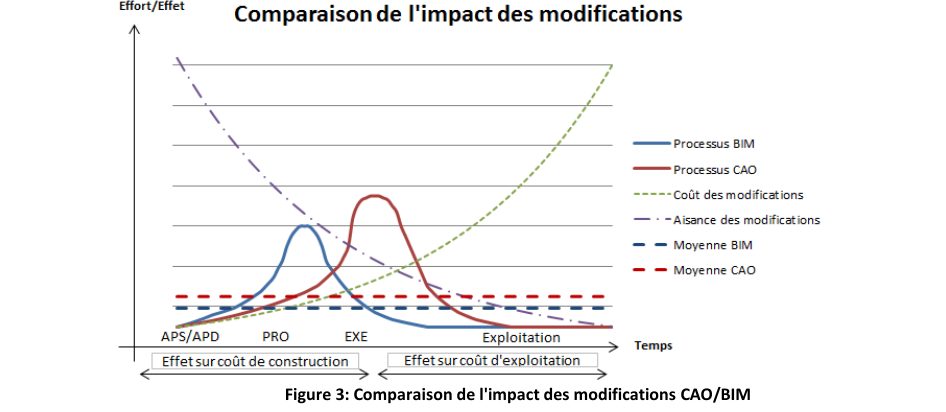
A significant consequence: the BIM process does not incur an overall additional cost compared to the traditional process, but rather a shift of effort towards the design phases. Understanding this point is essential to convince both management and teams. It involves demonstrating that the initial investment in time and resources during the upstream phases is largely offset by efficiency gains, a reduction in errors and costly modifications, and improved collaboration downstream in the project.
Two phases: develop then deploy
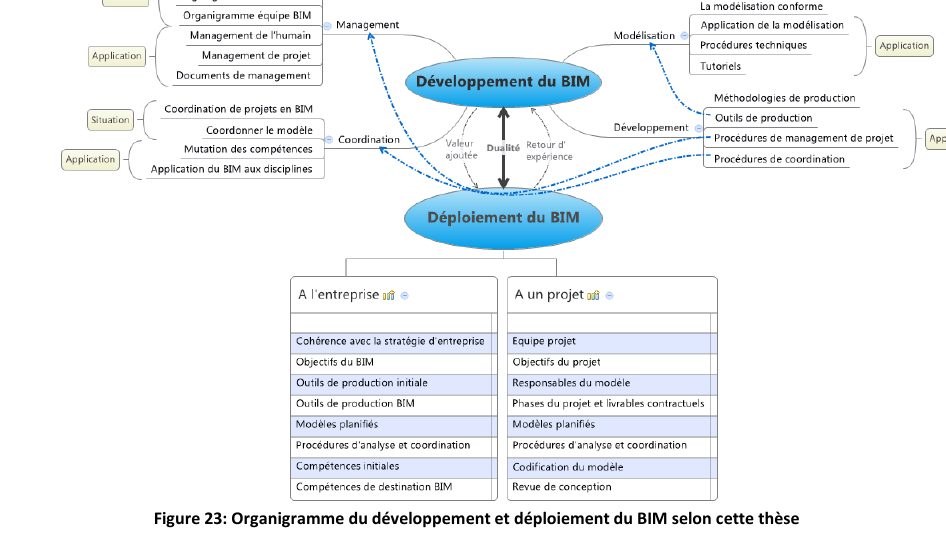
The organisational chart proposed in the thesis distinguishes two main blocks:
- BIM Development: management (BIM team organisational chart, human resources management, project management), modelling (compliance, modelling application, technical procedures, tutorials), coordination and production methodologies.
- BIM Deployment: at the company level (consistency with strategy, objectives, initial production tools and BIM, planned models, analysis and coordination procedures, skills) and at the project level (project team, objectives, model owners, contractual phases and deliverables, coding).
Where to start concretely
- Assess the company's BIM maturity (previous experience, skills, strategy).
- Identify obstacles: cost, lack of skills, resistance to change.
- Define a deployment methodology and a measurable pilot project.
- Train and develop existing skills rather than replacing them.
- Formalise procedures, templates, BIM protocols, and execution plans.
- Capitalise on project feedback project after project.
Concrete case in a design office
Imagine a structural engineering design office, accustomed to 2D CAD processes for decades. The management wishes to adopt BIM to remain competitive and meet the increasing demands of clients.
Rather than directly purchasing Revit or Tekla licenses, the first step is an internal assessment. What are our current projects? What are the 3D modelling skills of our engineers and technicians? Which software are we already proficient in? Where are our current bottlenecks in the study phase? Which clients are already requesting BIM from us?
Next, the design office could appoint an internal BIM lead (or rely on an external consultant like PALLADION) to manage the project. This lead would conduct interviews to understand the team's apprehensions and expectations. They would identify a pilot project of moderate size, non-critical, to begin the experimentation. The objective would not be immediate performance, but learning and process establishment.
Targeted training would be implemented for a few willing modellers and engineers, focusing on functionalities specific to their trade (rebar modelling, integrated structural calculations, etc.). A project template specific to the design office would be gradually developed, incorporating their drawing and nomenclature standards. The initial models would be checked using clash detection tools (e.g., Navisworks) against architectural and MEP models to identify coordination issues very early on, even before the definitive 2D drawings are produced from the model.
Only after several months of experimentation and adjustments on this pilot project would licenses be rolled out more broadly, accompanied by continuous training and personalised support for each new team. The goal would be to build a solid foundation of knowledge and confidence before wider deployment.
Step-by-step method
The BIM transition is a structured journey. Here is a 6-step approach to guide your organisation:
1. Audit and Strategy (Preliminary Phase):
BIM maturity audit* (technical, organisational, human) and identification of existing processes.
Definition of strategic objectives* for the BIM transition (error reduction, collaboration improvement, productivity gains, response to tenders) in line with ISO 19650, which governs information management.
Identification of necessary internal and external resources* (hardware, software like Autodesk Revit or ARCHICAD, training, consulting).
2. Team and Standards Setup (Preparatory Phase):
Formation of a dedicated BIM team* (BIM Manager, BIM Coordinators, modellers) or designation of internal leads.
Development or adaptation of internal BIM documentation*: BIM Protocol, BIM Execution Plans, modelling procedures. These documents define the rules for data production and exchange.
Preparation of project templates* specific to the company and its trades.
3. Training and Skill Development (Acquisition Phase):
Development of a personalised training plan* for different stakeholders (management, project managers, modellers, coordinators).
Support* for teams on chosen BIM software and collaborative working methodologies.
Awareness-raising* on interoperability via open formats like IFC (Industry Foundation Classes) and collaboration tools like BCF (BIM Collaboration Format).
4. Pilot Project and Experimentation (Application Phase):
Selection of a pilot project* of moderate complexity to experiment with new methods and tools.
Clear definition of BIM objectives* and deliverables for this project.
Implementation of developed BIM processes*, with close monitoring by the BIM team.
Use of conflict detection tools* (clash detection, e.g., with Navisworks or Solibri) and validation tools (model checking against requirements).
5. Capitalisation and Optimisation (Continuous Improvement Phase):
Collection of feedback* (Lessons Learned) from the pilot project.
Analysis of successes and difficulties encountered*, and identification of areas for improvement.
Adjustment* of procedures, templates, and training based on feedback.
Evaluation of gains* (time, cost, quality) and difficulties encountered.
6. Widespread Deployment and Monitoring (Sustaining Phase):
Extension of BIM deployment* to a greater number of projects and teams.
Establishment of a technology and regulatory watch process* (new software versions, ISO 19650 developments, etc.).
Integration of BIM* into company culture and recruitment processes.
Best practices / Common mistakes
| Best Practices | Common Mistakes |
|---|---|
| Involve management and teams from the start. | Impose BIM without consultation. |
| Define clear and measurable objectives. | Having a vague vision of what BIM should deliver. |
| Start with a pilot project to learn. | Launch BIM on a complex and critical project. |
| Invest in continuous training and support. | Purchase licenses without a training plan or support. |
| Develop internal standards (templates, BIM protocol). | Fail to formalise methods, allowing everyone to do as they please. |
| Develop existing skills. | Replace long-standing employees with new "BIM experts". |
| Capitalise on feedback and adjust processes. | Fail to address encountered difficulties, repeating mistakes. |
| Focus on interoperability (IFC, BCF) and collaborative platforms. | Work in silos with non-exchangeable proprietary formats. |
| Celebrate successes, however small, to motivate teams. | Never measuring impact and discouraging initiatives. |
Points of vigilance
The BIM transition, though strategic, is not without potential pitfalls. Here are the main points requiring constant vigilance:
- Resistance to change: This is one of the most significant obstacles. Transparent communication, team involvement, and highlighting individual benefits are crucial to overcome inertia.
- High initial cost: The investment in software licenses (Revit, Archicad, Tekla Structures, Navisworks, etc.), powerful computer hardware, and training can seem substantial. It is essential to position it as a long-term strategic investment with a clear ROI (Return on Investment), often not directly monetary at first (error reduction, improved image).
- Lack of internal skills: The transformation requires new skills. Failing to anticipate this need or inadequately training existing teams will lead to failure. The recruitment strategy must also be aligned.
- Software interoperability: Not all stakeholders use the same tools. The ability to exchange reliable data via open formats like IFC (Industry Foundation Classes) is fundamental. Do not neglect learning and implementing these standards.
- Data and model quality: A model is only useful if its information is reliable and structured. Defining clear modelling conventions and regular data quality checks are essential to avoid "garbage in, garbage out".
- Technological and normative developments: BIM is a constantly evolving field. Technology watch and understanding standards like the ISO 19650 series (which governs information management throughout the life cycle of built assets) are essential to maintain a relevant and up-to-date BIM strategy.
- Unrealistic expectations: BIM is not a magic solution. It is important to manage expectations, particularly in terms of productivity, which may initially decrease before rising significantly. The first few years are years of learning and investment.
What not to do
- Purchase licenses without a training plan or pilot project.
- Impose BIM without involving designers and project managers.
- Measure success on the first project, when productivity initially decreases.
- Confuse 3D modelling with the BIM process.
Key takeaways
- BIM is a business transformation, not a software purchase.
- Effort shifts upstream without an overall additional cost.
- Develop (methods, management) before deploying (company, projects).
- Start by assessing maturity and obstacles.
Article based on the professional thesis "BIM transition and optimised deployment, applied in an engineering firm".
Mickael Quinart, PALLADION
Want to go further?