
BIM · 7 min read
Self-assessing your firm's BIM maturity: the BIMetric grid
By Mickael Quinart · 9 October 2026
Prior experience, skills and strategies: use the BIMetric grid to position your company and track its progress year after year.
Hello everyone, Mickael Quinart, BIM/CAD consultant at PALLADION.
Adopting BIM has become a strategic necessity for any company in the construction and engineering sector. However, assessing one's own progress and identifying areas for improvement can prove complex. This is where the BIM maturity assessment tool comes in, designed to guide you through this process. This enriched blog post aims to be an educational guide to help you understand, use, and leverage this type of evaluation.
An assessment tool shared by the profession
The BIM Management working group from Mediaconstruct and BIMetric has developed a BIM maturity assessment grid for companies. This thesis uses it to evaluate the engineering firm under study, and then to measure its progress. This tool is not just a simple checklist; it is a structured framework that allows organisations to precisely position themselves on a maturity scale and to define clear objectives. It is based on a deep understanding of BIM processes and the challenges faced by companies.
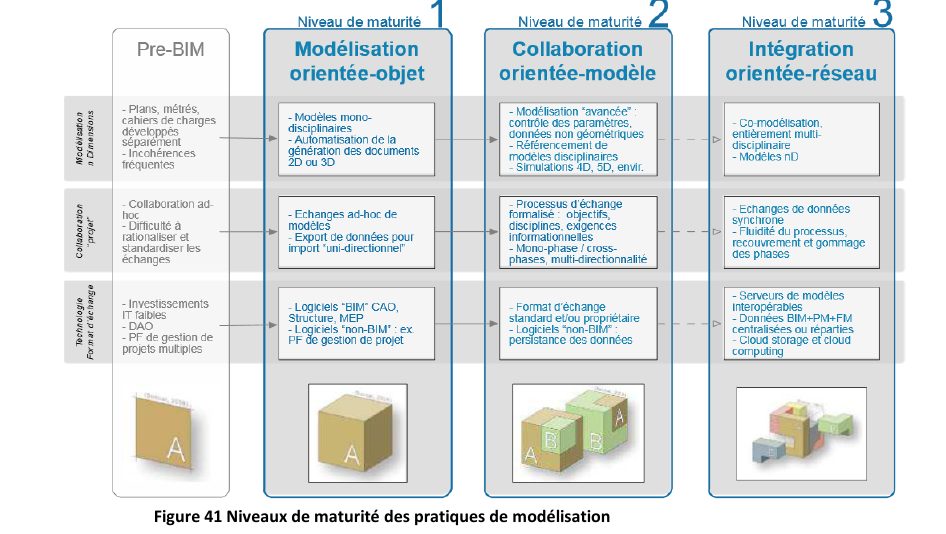
The image above illustrates the typical progression of modelling practices within a company. From Level 1, often characterised by isolated use of modelling software, up to the most advanced levels incorporating extensive interdisciplinary collaboration and exploitation of lifecycle data, each step represents increasing maturity and enhanced benefits.
The three families of criteria
To obtain a holistic view of BIM maturity, the assessment is structured around three main families of criteria, each exploring a fundamental aspect of BIM integration within the company:
| Family | Examples of criteria |
|---|---|
| Prior experience | Number of BIM operations, internal and external collaboration, instrumentation |
| Prior skills | BIM in design, programming, construction, operation |
| Prior strategies | Organisation, formalisation of practices, support, contractualisation |
Each criterion is scored on a progressive scale; the result is displayed as a radar chart, which is very insightful for management. This graphical visualisation allows for an instant identification of strengths and weaknesses, facilitating strategic decision-making.
Ten questions to get started
To get a preliminary idea of your situation, here are ten essential questions covering the fundamental aspects of BIM integration:
- How many BIM projects have you delivered in the last two years?
- Do you exchange IFC models with your partners?
- Do you have company templates and libraries?
- Is a BIM Execution Plan signed on your projects?
- Who coordinates the models and how often?
- Do your teams have a BIM training plan?
- Do you measure the time spent on modelling?
- Do you use BCF for observations?
- Has management set BIM objectives?
- Do you capitalise on lessons learned?
These questions are only the starting point for a more in-depth assessment, but they help to initiate reflection and highlight areas where improvements could be made.
Case study in an engineering firm
Let's imagine a structural engineering firm, primarily working on residential and commercial projects. The company began using BIM approximately three years ago, mainly at the request of certain clients.
By answering the preliminary questions and delving deeper with the Mediaconstruct/BIMetric grid, the assessment could reveal the following points:
Experience:* The company has delivered a dozen BIM projects over the last two years, but collaboration with other trades (architects, MEP) often remains limited to importing reference models without real bidirectional interaction. Instrumentation of BIM projects (performance measurement, identification of bottlenecks) is almost non-existent.
Skills:* The teams are proficient in modelling software (e.g., Revit for reinforcement, Advance Steel for steel structures) for the structural design and execution phases. However, knowledge of BIM for programming, multidisciplinary coordination, or operation is low, as it has not been requested until now.
Strategies:* The organisation is still very much "project by project", without a formalised company-wide BIM policy. Some templates and libraries exist, but they are not very standardised or up-to-date. Management supports BIM, but objectives are neither quantified nor clearly communicated. BIM contractualisation is often managed on a case-by-case basis, without an internal agreement template.
The radar chart results would show strong peaks in modelling and occasional internal collaboration, but significant troughs in strategy, instrumentation, capitalisation, and advanced interoperability (such as the use of IFC for structured data exchange, not just visual). This observation would allow for targeting priority actions, such as appointing an internal BIM champion, creating a structured training plan, or developing a company BIM charter.
Best practices / Common mistakes
| Best practices | Common mistakes |
|---|---|
| Clear strategic vision: Define BIM objectives aligned with the company's overall strategy. | Isolated tactical approach: Using BIM only to meet client demand without integration. |
| Continuous training: Regularly invest in developing team skills. | Ad-hoc and limited training: Contenting oneself with initial training without updates or further development. |
| Internal standardisation: Develop and maintain internal templates, libraries, and processes. | Excessive reliance: Failing to capitalise and redoing work on each project or relying on external resources. |
| Open collaboration: Encourage structured exchanges via IFC, BCF with partners. | Siloed working: Using BIM internally without real interoperability with other project stakeholders. |
| Measurement and capitalisation: Evaluate effectiveness, document lessons learned, and adjust processes. | Lack of monitoring: Failing to measure benefits or difficulties, and not learning from past projects. |
| Management support: Involve management in the BIM strategy and communication of objectives. | Lack of managerial commitment: Leaving BIM to technicians without management support or clear objectives. |
Step-by-step method
To conduct an effective assessment of your BIM maturity and derive concrete action plans, follow these steps:
- Preparation and Engagement: Raise awareness and secure the commitment of management and key teams. Identify relevant participants for the assessment (modellers, project managers, technical management, general management).
- Data Collection: Use the assessment grid (such as Mediaconstruct/BIMetric's) to interview teams and gather information on experiences, skills, and strategies. Be factual and do not hesitate to ask for evidence (signed BIM Execution Plans, model screenshots, training plans).
- Analysis and Visualisation: Consolidate data and generate the maturity "radar chart". Identify the weakest criteria and the strong points. contextualise the results with the company's strategic objectives.
- Definition of Objectives and Priorities: Based on the analysis, set a realistic target level for each criterion within a given timeframe (e.g., 6 months or 1 year). Identify the three to five priority actions that will have the greatest impact on improving maturity.
- Detailed Action Plan: For each priority action, define a concrete plan with assigned responsibilities, deadlines, necessary resources, and Key Performance Indicators (KPIs). This may include training, implementing new tools, or writing internal procedures.
- Monitoring and Reassessment: Implement the action plan. Schedule periodic reassessment (e.g., annually) of BIM maturity to objectively track progress, measure the return on investment of efforts, and adjust the strategy if necessary.
Points of vigilance
- Subjectivity of self-assessment: Be honest and critical. Self-assessment can sometimes mask weaknesses. A collaborative approach with multiple stakeholders can reduce this bias.
- Data quality: Ensure that responses are based on facts and not on impressions.
- Realistic objectives: Setting overly ambitious or unachievable objectives can discourage teams. Progress should be incremental.
- Lack of follow-up: The assessment is only a starting point. Without an action plan and rigorous monitoring, efforts risk being fruitless.
- Team buy-in: The success of the BIM approach relies on everyone's involvement. Explain the "why" behind the assessment and the resulting actions.
Leveraging the results
- Identify the weakest criteria: these are the priorities.
- Set a realistic target level for one year.
- Reassess annually to objectify progress and return on investment.
Normative benchmarks and tools can greatly support your approach. ISO 19650 is the international standard for information management throughout the lifecycle of built assets using BIM. It provides a structured framework for information processes. For data exchange, the IFC (Industry Foundation Classes) format is essential for interoperability between software (such as Revit or other modelling software). Communication of observations and non-conformities can be managed efficiently via the BCF (BIM Collaboration Format). Finally, software like Navisworks is indispensable for multidisciplinary model coordination, clash detection, and 4D/5D visualisation.
Key takeaways
- The BIMetric grid assesses experiences, skills, and strategies.
- The radar chart makes maturity readable for management.
- Annual assessment drives progress.
Supplement this self-assessment with a concrete measurement: test one of your models with the site's free BIM analysis. This will provide you with additional technical insight into the quality of your outputs.
Article based on the professional thesis "BIM transition and optimised deployment, applied in an engineering firm".
Mickael Quinart, PALLADION
Want to go further?