
Stratégie · 8 min read
Strategic diagnosis before BIM: Porter, LCAG and PIMS applied to engineering firms
By Mickael Quinart · 9 October 2026
Before investing in BIM, analyse the market and the firm's internal strengths with LCAG, PIMS and Porter's five forces.
Hello, I'm Mickael Quinart, a BIM/CAD consultant at PALLADION. This article is an essential guide for companies, particularly design offices, looking to initiate or optimise their BIM transition. It's about a deep strategic approach, far removed from simply acquiring software.
Understanding the Business Before Transforming It
A successful BIM deployment starts with a management question: which strategic position do we want to strengthen? This thesis employs three classic management tools to answer this. Approaching BIM without this prior reflection risks transforming a competitive lever into a cost centre.
Why a Strategic Approach?
BIM is not just a technical matter. It's a transformation of work processes, an evolution of skills, and often, a redefinition of the company's value chain. As a consultant, my role is to help organisations align their BIM ambitions with their overall business objectives. This alignment is crucial to ensure internal buy-in and the relevance of investments.
External Diagnosis: Porter's Five Forces and PIMS
Porter's Five Forces describe competitive pressure: customers, suppliers, competitors, new entrants, substitute products. In engineering, BIM alters several forces simultaneously: clients demand it, new specialised players emerge, and the model becomes a deliverable in its own right.
- Intensity of Competition: BIM is becoming a prerequisite in many tenders. Companies not equipped lose competitiveness.
- Bargaining Power of Customers: Clients require BIM deliverables (digital models, associated data) to better manage their assets throughout their lifecycle.
- Threat of New Entrants: Start-ups or entities specialising in BIM can emerge and compete with traditional players in specific niches.
- Threat of Substitute Products: BIM, by offering better predictability and project management, reduces the appeal of less efficient traditional methods.
- Bargaining Power of Suppliers: BIM software publishers and specialised trainers see their importance grow.
The PIMS (Profit Impact of Market Strategy) matrix links profitability to market share and perceived quality. It helps to position the design office: to position BIM as a differentiating element through quality, rather than as a mere additional cost. A design office that strategically adopts BIM can improve the quality of its deliverables, reduce errors, optimise deadlines, and ultimately, increase its profitability by positioning itself in higher-value markets.
Internal Diagnosis: The LCAG Method
The LCAG (Learned, Christensen, Andrews, Guth — Harvard) method cross-references internal strengths and weaknesses with external opportunities and threats (the SWOT principle).
| Positive | Negative | |
|---|---|---|
| Internal | Business expertise, references, stable team | Limited BIM skills, heterogeneous tools |
| External | Growing BIM demand, public markets | Equipped competition, price decreases |
This SWOT (Strengths, Weaknesses, Opportunities, Threats) analysis is fundamental. It allows for an understanding of the company's current capabilities in the face of market challenges and opportunities.
- Internal Strengths: These assets should be leveraged to facilitate the BIM transition. Solid business expertise, for example, allows for pertinent modelling.
- Internal Weaknesses: These represent the main obstacles to overcome. A mapping of BIM skills and software tools is essential here.
- External Opportunities: BIM opens doors. Public markets, in particular, increasingly incorporate BIM requirements, offering new opportunities for prepared companies.
- External Threats: Non-adoption of BIM, or late and poorly orchestrated adoption, can lead to a loss of market share against more agile competitors.
Connecting Diagnosis to Obstacles
The diagnosis reveals the real obstacles — cost, skills, resistance to change — and allows them to be addressed in the correct order.
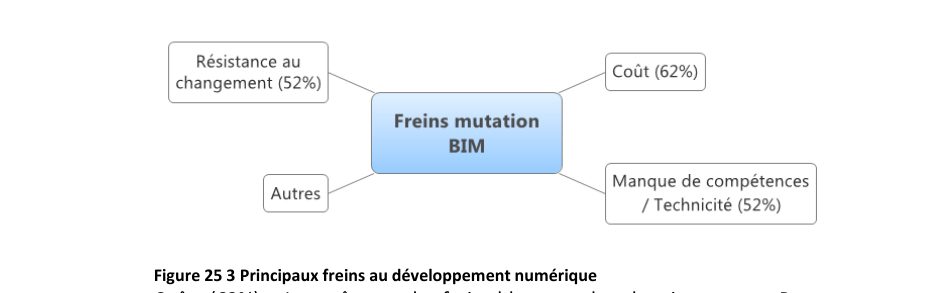
These obstacles are interconnected. Perceived cost is often linked to a lack of clear skills and resistance to change. A well-defined BIM strategy must address these three points head-on:
1. Cost: Justify the investment by the expected return on investment (ROI), error reduction, improved deadlines, and the ability to access new markets.
2. Skills: Implement appropriate and progressive training plans, potentially recruiting specific profiles. Continuous training is key.
3. Resistance to Change: Communicate clearly on the benefits of BIM, involve teams from the outset, show concrete success stories, and appoint internal BIM champions.
Concrete Case in a Design Office
A medium-sized structural design office (around 30 people) wants to position itself on large-scale projects requiring BIM deliverables. The initial diagnosis reveals strengths (recognised technical expertise, stable and engaged team) but also weaknesses (predominantly 2D working methods, very heterogeneous BIM skills, lack of interoperability between existing software). The opportunities are clear: growing demand from clients and architects for structural studies in BIM, allowing for better coordination and clash detection. Threats include competition from more BIM-mature design offices and the risk of losing projects.
The design office then decides to strengthen its strategic position by becoming a reference player in structural BIM. This involves a detailed audit phase of its current processes, an evaluation of its tools, and an analysis of its employees' skills. The objective is not to do BIM for BIM's sake, but to use this methodology to improve the quality of its studies, reduce the risk of late modifications, and optimise coordination with other trades. Deployment will be phased, with an emphasis on team training, the progressive adoption of BIM software (e.g., Revit for modelling, IFC-compatible structural analysis tools, Navisworks for clash detection), and the implementation of collaboration processes based on standards such as ISO 19650 for information sharing.
Step-by-Step Method
To successfully deploy BIM, follow these key steps:
- Strategic Diagnosis (1-2 months): Conduct an in-depth analysis (Porter, PIMS, LCAG/SWOT) to understand your current positioning and ambitions. Identify relevant BIM uses for your activity (e.g., 3D coordination, clash detection, quantification, energy simulation).
- Definition of BIM Objectives and Strategy (1 month): Establish SMART (Specific, Measurable, Achievable, Relevant, Time-bound) objectives for your BIM transition. Define a clear vision and the strategic steps to achieve it. This may include ISO 19650 certification objectives, for example.
- Operational Planning and Budgeting (1-2 months): Develop a detailed roadmap including investments (software, hardware, training), necessary human resources, and a provisional timetable. Integrate the acquisition of licences for key software (such as Autodesk Revit, Archicad, Tekla Structures, Navisworks Manage) and collaborative platforms (CDE - Common Data Environment).
- Training and Skill Development (ongoing): Implement a training programme adapted to different profiles (modellers, project managers, management). Encourage continuous learning and technological watch on tools such as BCF (BIM Collaboration Format) for communicating feedback.
- Progressive Implementation and Pilot Projects (6-12 months): Start with low-risk pilot projects to test new methods, tools, and processes. Document lessons learned to adjust the strategy.
- Monitoring, Evaluation, and Continuous Improvement (ongoing): Set up Key Performance Indicators (KPIs) to measure the impact of BIM on your projects and profitability. Adjust your strategy based on results and technological and normative developments (e.g., new IFC versions, evolution of client requirements).
Best Practices / Common Mistakes
| Best Practices | Common Mistakes |
|---|---|
| Involve management from the outset | View BIM as a purely technical initiative |
| Define clear BIM objectives aligned with the strategy | Purchase software without a defined usage strategy |
| Invest in training and skill development | Underestimate the need for training and change management support |
| Implement a progressive and realistic roadmap | Try to do everything at once without a pilot phase |
| Communicate regularly on BIM progress and benefits | Lack internal communication and team buy-in |
| Adopt open standards (e.g., IFC, BCF) for interoperability | Remain locked into a proprietary software ecosystem |
| Use a CDE (Common Data Environment) for collaboration | Work on isolated files or unconnected platforms |
| Measure ROI and continuously adjust the strategy | Fail to monitor performance and adjust the plan |
Points of Vigilance
The BIM transition is a marathon, not a sprint. Several points require particular attention to ensure success:
- Management Buy-in: Without clear and continuous support from leaders, the transformation will fail. BIM must be perceived as a strategic investment, not a mere expense.
- Change Management: Employee resistance is natural. Transparent communication, adapted training, and the establishment of internal "BIM champions" are essential to motivate teams.
- Interoperability: The construction sector uses a multitude of software. The adoption of open formats like IFC (Industry Foundation Classes) is crucial to ensure data exchange between different project stakeholders. Tools like BCF (BIM Collaboration Format) facilitate the communication of feedback.
- Tool Selection: Do not rush to the latest trendy software without a prior analysis of needs. Solutions like Autodesk Revit, ARCHICAD, Allplan for modelling, or Navisworks for coordination and clash detection, are references, but their relevance will depend on your target uses.
- Standardisation: Standards like ISO 19650 (Organisation and digitisation of information about buildings and civil engineering works, including building information modelling - Information management using building information modelling) provide an essential framework for information management throughout the project lifecycle. Conforming to them ensures effective collaboration and better quality deliverables.
- Data Security: With the increase in data exchanges, the security and confidentiality of information become paramount.
Deliverables of the Diagnosis
- A one-page strategic summary shared with management. This concise document must encapsulate the vision, challenges, and broad outlines of the BIM approach.
- BIM objectives linked to the strategy (target markets, priority uses). These objectives must be clear and measurable, for example: "Reduce non-conformities in the design phase by 15% through BIM coordination within 2 years."
- A budgeted and planned roadmap. This detailed action plan includes steps, resources, responsibilities, and deadlines.
- Indicators to monitor the effect of deployment. Regular monitoring of KPIs (Key Performance Indicators) allows for strategy adjustment and measurement of the ROI (Return on Investment) of BIM efforts.
Key Takeaways
- BIM is decided at a strategic level.
- Porter and PIMS for external, LCAG for internal.
- The diagnosis prioritises obstacles and guides the roadmap.
- ISO 19650, IFC, and BCF are key normative and technological benchmarks.
Article based on the professional thesis "BIM transition and optimised deployment, applied in an engineering firm".
Mickael Quinart, PALLADION
Want to go further?